
Bhubaneswar, 21st June, 2026:
The Jan Vishwas Act, 2026 has been published in the Gazette of India after receiving the assent of the Honorable President. Under the Act, amendments have been made to various sections of the Railways Act, 1989.
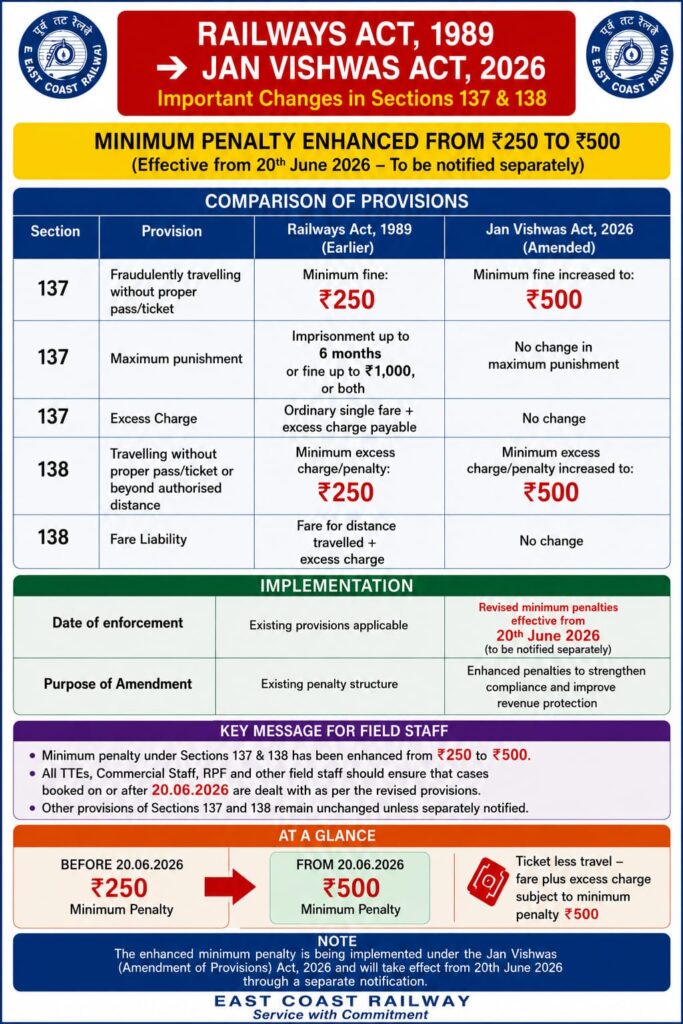
According to the amended provisions, under Section 137 of the Railways Act, the minimum amount of excess charge payable for traveling or attempting to travel without a valid ticket or pass with the intent to defraud the railway administration has been increased from Rs 250 to Rs 500. In case of non-payment, the concerned matter can be presented before the competent court.
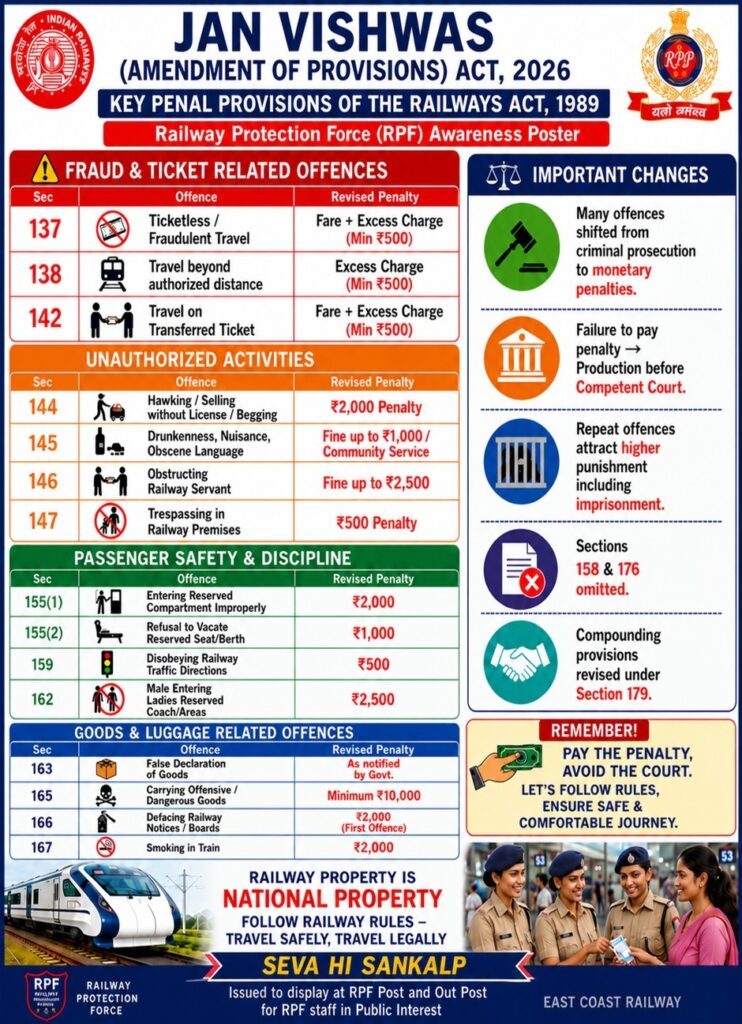
Under Section 138, the minimum excess charge in cases of traveling without a ticket or beyond the authorized distance has also been fixed at Rs 500 instead of Rs 250. Additionally, under Section 142, a person found traveling on a transferred ticket will be charged a minimum excess charge of Rs 500 in addition to the fare.
In Section 144, the penal provisions regarding hawking, selling goods, or begging in railway premises or trains without permission have been amended. In such cases, a fine of up to Rs 2,000 can be imposed. In case of repeated violations, provisions for imprisonment and a fine of up to Rs 5,000 have also been made.
Under Section 145, a fine of Rs 1,000 can be imposed for being found in a state of intoxication, causing inconvenience to passengers, committing any nuisance or obscene act, using abusive or obscene language, and interfering with the amenities provided by the railways in trains or railway premises. If the nuisance continues even after a warning, a provision of imprisonment for up to six months or a fine of up to Rs 5,000 or both has been made.
Under Section 146, the penal provisions related to obstructing a railway servant in the discharge of their lawful duties have been amended, and the amount of the prescribed fine has been increased.
Under Section 147, a fine of Rs 500 can be imposed on persons committing unauthorized entry, trespassing into the passenger area or other railway premises, or refusing to leave the premises. In serious or repeated cases, provisions for imprisonment and a fine of up to Rs 5,000 have also been made.
In Section 155, the amount of fine in matters related to the violation of rules prescribed by the railway administration has been amended. A fine of Rs 2,000 has been fixed under sub-section (1) and Rs 1,000 under sub-section (2). On failure to pay the fine, a fine of up to Rs 3,000 can be imposed by the competent court.
Under Section 159, a fine of Rs 500 can be imposed on drivers or conductors of vehicles in railway premises for disobeying the lawful directions of a railway servant or police officer or for causing obstruction to traffic. In case of non-payment of the fine, provisions for imprisonment or an additional fine by the court have been made.
According to Section 162, a person entering or occupying a compartment, coach, berth, seat, or other places reserved for females without a valid reason will be fined Rs 2,500 and can be removed therefrom by a railway servant. On failure to pay the fine, a fine of up to Rs 5,000 can be imposed by the competent court.
In Section 163, the penal provisions related to goods transported by the railways have been amended, and a provision has been made for the amount of fine to be notified by the Central Government.
Under Section 165, a minimum fine of Rs 10,000 has been fixed for bringing or delivering offensive or prohibited goods on the railways for transport. In addition, the concerned person will be liable for any loss or damage caused to the railway. In case of refusal to pay, provisions for imprisonment for up to one year or a minimum fine of Rs 10,000 or both have been made.
Amending Section 166, a fine of Rs 2,000 has been fixed for the first violation, while for the second or subsequent offenses, provisions for imprisonment for up to one month or a fine of up to Rs 5,000 or both have been made.
About the Author